The Georgetown Conditions Behind Striped Bark Scorpions
Striped bark scorpions turn up around Georgetown because the ground gives them what they need: limestone with loose rock, cedar and live oak cover, and the gaps a dry summer opens at the slab edge. New construction near a greenbelt disturbs that ground directly, so a lot next to open land off Westinghouse Road or DB Wood Road pushes them toward the nearest house. They climb, and their bodies flatten enough to work through a weep hole or door gap chasing moisture toward a bathroom or laundry room.
New construction adds to it. With cleared lots pushing displaced animals toward the houses next door, a fresh subdivision near Wolf Ranch or Teravista can see more scorpion activity for a season or two than an established street in Old Town, simply because the rock and brush piles they were living in got bulldozed.
Georgetown splits along I-35. On the Sun City and Cimarron Hills side, limestone sits close under a thin caliche layer, cracked enough to move water sideways instead of down, which is why scorpions turn up in bathrooms after rain. The Water Oak and DB Wood Road stretch shares that rock. East toward Teravista the clay holds moisture differently, and roof rats still enter at the eaves either way.
Know What You Are Looking At
- Size and body shape
- About two to three inches, tan to yellow
- Two dark stripes on back
- Dark stripes running down the abdomen
- Tail and stinger
- Slender curved tail carried up and over
- Where it hides
- Under loose rock, bark, and siding
- When it shows up
- Bathrooms, laundry rooms, and shoes indoors
- Same-Week Availability
- Active April through October, worst during Georgetown's hot June through August stretch, quiet only in deep winter
- One-Time Treatment
- an estimated $89–$189
Talk to a Local Pro Now
other scorpion species. The stripes settle it. A house centipede has long, obvious legs running the full length of its body and no curled tail; a beetle has a hard, rounded shell and no tail or pincers at all. The striped bark scorpion has pincers, a slender curled tail, and the two dark stripes down a pale body, which nothing else in a Georgetown house combines.
How Striped Bark Scorpions Get Dealt With Properly
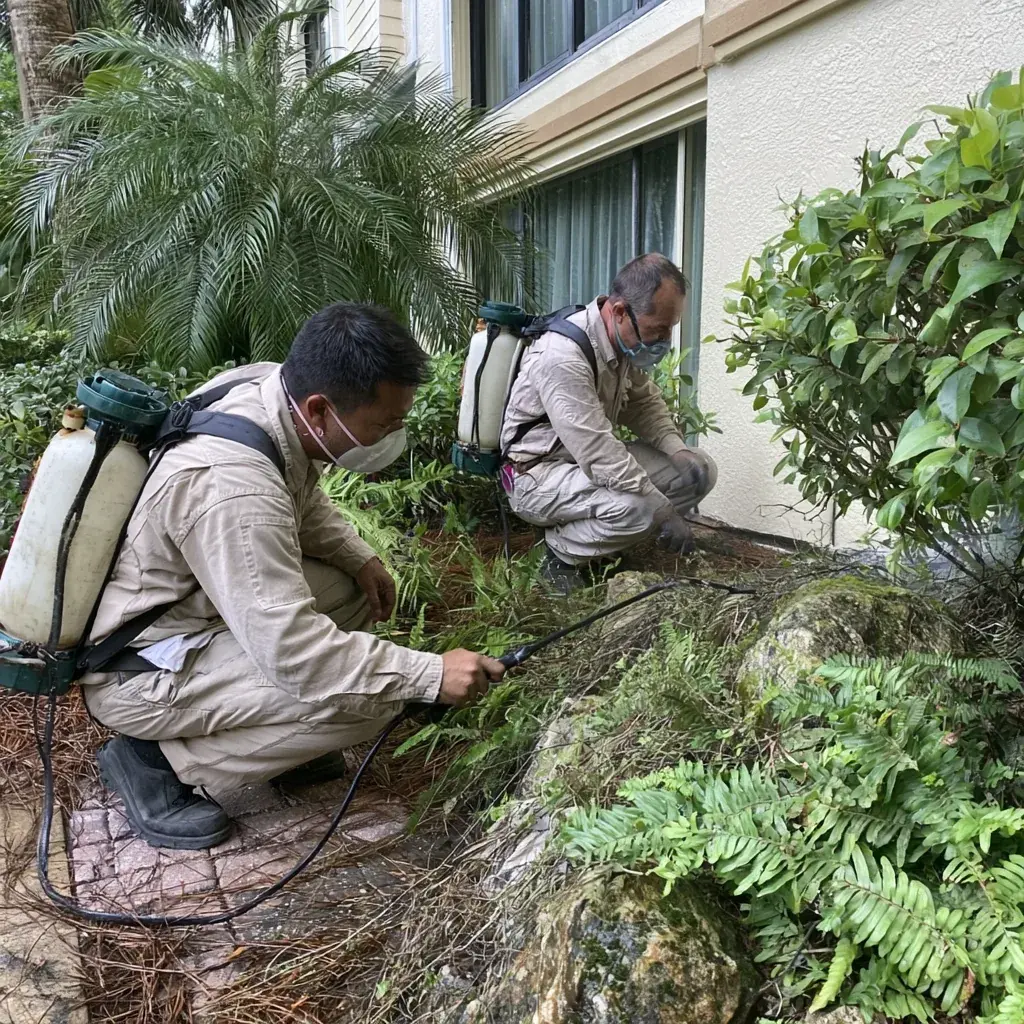
Treatment starts outside, at the entry points, not inside on the scorpion somebody already found. The licensed pros we connect you with focus on weep holes, door sweeps, foundation gaps and the perimeter band where the scorpion is actually crossing from rock or mulch into the wall.
A residual barrier around the foundation and under-eave areas, paired with sealing the gaps a dry summer opens up at the slab edge, is what actually holds. After a long drought breaks and the clay swells back, that seal can shift, so a repeat visit later in the season is normal, not a sign the first one failed.
Ask a Georgetown pest tech which side of I-35 they'd rather work and most pick east without hesitating. West of the highway the ground is thin limestone with cracks running sideways underneath it, which is a different kind of trouble than the dark prairie clay on the east side. Berry Creek and the Serenada area sit right on that seam, and it shapes what shows up at the door more than the calendar does.
One call, one honest quote
| Limestone Ground, Local Pests |
Fast Help Near Lake Georgetown |
|---|
| Fall crickets swarming lights near Wolf Ranch and I-35 | Scorpions Under Doors |
| Why the west side of I-35 sees more scorpion calls | Fire Ant Mound Alerts |
| Scorpion and roof rat calls from Sun City to Old Town | Roof Rats Enter Above the Foundation |
The Homeowner Side of Striped Bark Scorpions
Store-bought sprays and glue boards catch the odd scorpion but do nothing about the gap it came through. Sealing visible cracks, weep holes and door sweeps yourself helps, and shaking out shoes and bedding before summer nights is a reasonable habit, but a scorpion problem tied to loose rock or a greenbelt lot behind the house is a perimeter job, not a can of spray.
The Health Side of Striped Bark Scorpions, Honestly
A striped bark scorpion sting is painful, similar to a bee or wasp sting, with localized swelling and numbness that usually resolves on its own. Reactions vary by person, and anyone with a severe reaction, a sting to a small child, or symptoms spreading beyond the sting site should be seen by a medical professional rather than waiting it out.
Ask About Your Property
Whether it's a roof rat that got into the attic off a tree limb near Berry Creek or crickets piling up under a porch light off Williams Drive, the fix starts with knowing which pest you actually have. The licensed pros we connect you with serve Georgetown and out toward Round Rock and Liberty Hill, and they'll ask the right questions before anyone sets foot on the property. Reach out today and get a straight answer instead of a guess.Scorpion visits usually come with an entry point already at fault — a slab crack, a loose weep screen, a gap around a laundry line. Fixing that spot is often folded into the same visit rather than billed as extra, since it's a few minutes of caulk and screen versus a repeat call in July. Roof rat exclusion works the same way: the estimate covers sealing the fascia gap or gable vent that let them into the attic in the first place, not just clearing what's already up there. pricing guide, and the service that handles this is General Pest Control.