Now taking calls — fast callback for urgent pest issues · (866) 829-2897
Rodent Exclusion in Georgetown, TX
Georgetown, TX

Sealing Georgetown Homes Against Mice and Rats

Rodent exclusion in Georgetown: sealing entry points, gaps and vents against roof rats and mice for good

A roof rat does not come up through the slab in Georgetown. It comes in overhead — along a fence line, down a live oak limb that touches the roofline, across a power drop into a gable vent left uncovered since the house was framed. That single fact changes how exclusion has to work here. In neighborhoods like Sun City and Teravista, where mature landscaping now shades the roof and the original construction gaps were never closed, the entry points sit at eave level and roofline, not at the foundation.

Exclusion is the work of finding every gap a mouse or rat can use and closing it with something they cannot chew through, then removing whoever is already inside before the building is sealed. It is not one trap and it is not a bait station on the patio. Done on a house near Wolf Ranch or out toward Berry Creek, it means a roofline check, a foundation check, and a hard look at the garage door seal and the dryer vent, because those are the gaps that keep reopening.

Rodent Exclusion in Georgetown, TX isn't one-size-fits-all, whether you're in Berry Creek, Teravista, Wolf Ranch, or elsewhere around Georgetown, we tailor the treatment to your property and the way roof rats behave here. That local focus is what separates a lasting fix from a temporary one.

Nearly all of this work is residential. residential pest control covers the approach for houses; commercial and multi-unit buildings are handled under commercial pest control.

Pests We Treat

  • Roof Rats
  • House Mice
  • Norway Rats
  • Attic Rodents
  • Fence-Line Rodents
Warning Signs

Signs You May Need Rodent Exclusion

Gnaw Marks and Runways

Droppings along a garage wall or in a cabinet under the sink are usually the first sign, followed by a gnaw mark on a corner of stored cardboard or a chewed hole in a bag of pet food. In an attic, the sign is a runway — a flattened, darkened trail through the insulation where the same animal has been going back and forth to the same entry point, usually a gable vent or a gap where the roof deck meets the fascia.

Where Roof Rats Actually Get In

Scratching or scurrying at night, especially right after dark, points to roof rats moving along the attic and soffit rather than mice at floor level. A homeowner near Cimarron Hills or Water Oak will often hear it directly above a bedroom ceiling, because that is where the roofline gap sits relative to the house, not because the rat has any particular interest in that room.

Ground-Level Entry Points

A greasy dark smear low on a wall or around a pipe penetration is a rub mark, left by the oil and dirt on a rodent's coat as it uses the same gap over and over. Combined with a chewed corner on a door sweep or a gap under a garage door that lets daylight through, it tells you where the runway is before a single trap goes down.

How It Works

Our Rodent Exclusion Process

Rodent Exclusion Service in Georgetown, TX

The inspection starts at the roofline, not the foundation, because that is where roof rats actually travel in Georgetown. The licensed pros we connect you with walk the exterior checking eaves, gable vents, roof-to-wall joints, fascia boards near overhanging limbs, and any gap where a utility line or pipe passes through the wall.

Sealing Entry Points in Georgetown

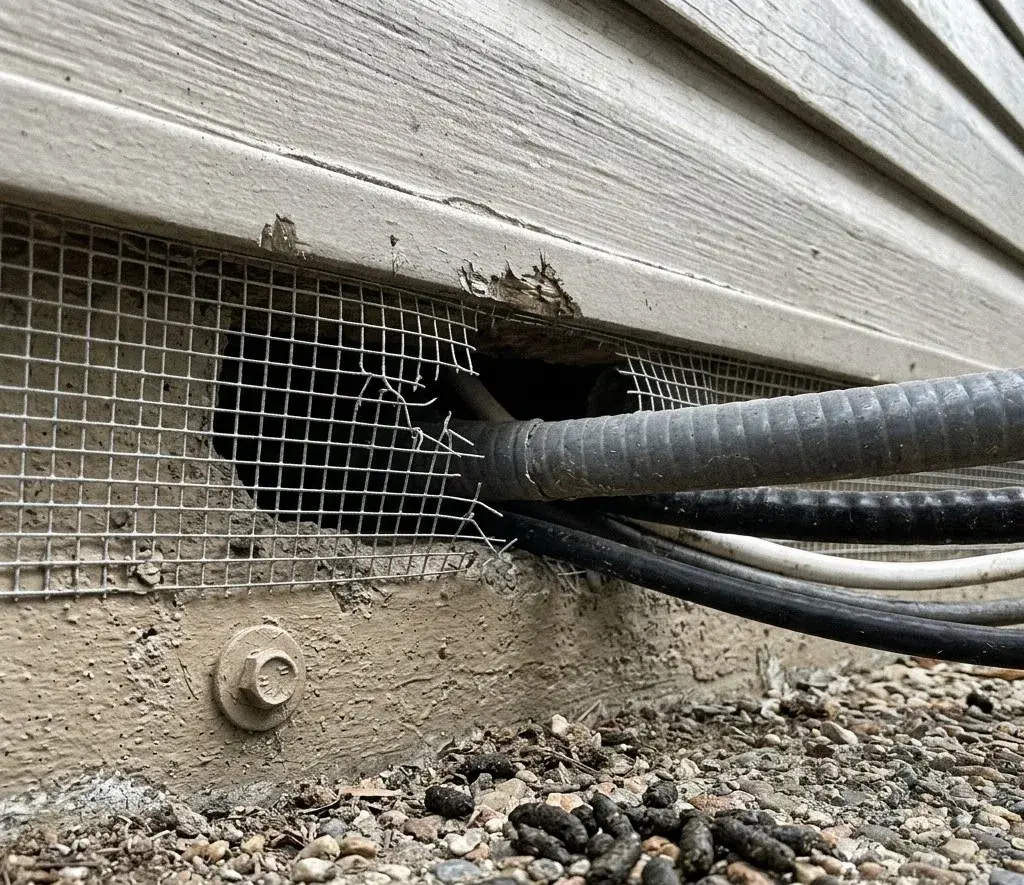
Every active and potential entry point gets sealed with material a rodent cannot gnaw through - galvanized hardware cloth, sheet metal flashing, or masonry patch, depending on the gap. Vents get screened rather than blocked outright so the house still breathes. Expanding foam alone is skipped for anything larger than a pencil gap, since it gets chewed through fast.

Interior Trapping During Seal-Up

Traps go inside during the seal-up, placed along the runways already identified in the inspection, because sealing a building with rodents still inside just locks them in. Snap traps do the work indoors where the goal is removal, not maintenance, and placement follows the droppings and gnaw marks rather than guesswork.

Final Exclusion Check, Georgetown

Bait stations alone outdoors do not solve an exclusion problem, since bait manages a population without closing the gap that let it in. Once entry points are sealed and interior traps have cleared active activity, a final walk confirms every gap identified in the first visit is closed and holding.

Why this matters

Georgetown houses put the roof close to mature trees and give a roof rat a running start from a limb, a fence line or a power drop straight onto the roof deck, which is why the entry points here sit up high far more often than at the foundation. Slab construction removes the crawl-space route that matters in other markets, so once the roofline gaps are found and closed, most of the exclusion problem in this town is solved. Skip the roofline and a bait station in the yard will not touch what is already living in the attic.

Licensing & Local Standards

Code-Compliant Rodent Exclusion in Texas

Live Oaks and Roofline Access

Slab construction around Georgetown means there is no crawl space and no sub-floor gap to check on most of the housing stock, which simplifies the foundation side of the inspection but puts almost all the weight on the roofline. Roof vents, gable vents, the gap where a roof-to-wall junction was never fully closed, and the point where a utility line enters the attic are the entry points that matter most, especially on homes backing onto a greenbelt near Garey Park or the San Gabriel River, where tree cover gives a rat a direct route to the roof.

Slab Edges and Older Construction

New construction on the west side of town, closer to the Balcones Escarpment and the limestone ground that runs through that half of Georgetown, tends to ship with gaps around plumbing stacks and HVAC lines that were never sealed at the builder stage. Older stock in Old Town and around Serenada has the opposite problem — original gable vents and foundation vents with screens that have rusted through or come loose over the years. Both situations get sealed the same way: hardware cloth or sheet metal at the gap, sealant only where it will actually hold, never expanding foam alone over a live entry point.

Local Pricing Factors

What Drives Pest Control Costs Here

Pricing in Georgetown depends on what you're dealing with. A one-time scorpion treatment along a Sun City or Cimarron Hills foundation costs less than an ongoing roof rat job that needs attic and eave work.

Get an Exact Number, Not a Guess
Attic AccessSlab CracksWeep Holes
One-Time Striped bark scorpions in Sun City and Cimarron Hills homes near the limestone an estimated $160–$525
Quarterly Scorpion and roof rat entry point checks for slab homes near Lake Georgetown and Sun City an estimated $190–$750
Bi-Monthly same-day and next-morning pest service across Georgetown, from Sun City to Old Town an estimated $285–$1200
Monthly Roof rats and attic entry points across Georgetown, from Sun City rooflines to Old Town eaves an estimated $455–$1995

Prices in Georgetown vary with what's actually happening at the property — a fire ant colony under a slab crack costs less to handle than a roof rat nesting above the fascia. Ask for a written estimate before work starts.

Questions & Answers

Frequently Asked Questions

How do roof rats get into a house if there's no hole in the roof?

Sealing the building matters more here because a roof rat's route into a Georgetown house is almost always overhead — a tree limb touching the roof, a gap at the fascia, an open gable vent — not through the foundation. Bait placed outdoors can reduce pressure around the yard, but it does nothing about an animal already living in the attic or wall void, and it does not close the gap that let it in. Exclusion is the only step that actually stops new animals from getting in.

Will steel wool or expanding foam actually keep mice out?

The most common entry points on Georgetown homes are gable vents without intact screens, gaps where the roofline meets the fascia, plumbing and HVAC line penetrations into the attic, and gaps under garage doors. On older housing stock around Old Town, foundation vents with rusted-through screens also show up. On newer construction near Wolf Ranch or Teravista, the gaps are more often builder-stage penetrations that were never sealed in the first place.

Why won't bait stations alone get rid of the rats in my attic?

Trapping happens during the seal-up, not instead of it. The idea is to close every entry point except one or two, set snap traps at those remaining points and inside the attic runway, and only seal the last gaps once trapping shows the activity has stopped. Sealing every gap on day one with animals still inside just traps them in the wall void.

Do you seal the house before or after removing the rodents?

Hardware cloth and sheet metal are the materials that hold up, because a rat or mouse can gnaw through expanding foam, plastic mesh and most weatherstripping given enough time. Foam has a place for filling a gap around a sealed material, but it is never the only barrier over an active entry point. Door sweeps and garage door seals get replaced rather than patched.

What's the smallest gap a mouse can actually fit through?

Bait stations placed around the yard target the rodents already outside and can reduce the population pressure near the house, but they do not seal anything and they do not remove an animal already living in an attic or soffit. In a slab-on-grade town like Georgetown, where the entry points are mostly at roof level, exclusion work has to happen for the bait to mean much long-term.

My weep holes are open - is that really how they're getting in?

Mature live oaks and other trees with limbs touching or overhanging the roofline are one of the more common ways a roof rat gets from the ground to the attic in Georgetown, particularly in older, established neighborhoods like Old Town or Serenada and on lots backing onto a greenbelt. Trimming limbs back from the roofline is a real part of prevention, alongside sealing the gaps the tree gave access to.

How much does rodent exclusion cost in Georgetown?

Roof rats explain why an attic inspection near Wolf Ranch or Teravista starts at the roofline, not the foundation. They travel fence lines and power drops into soffits and gable vents, so the fix looks upward. Fall field crickets are simpler: they swarm porch lights and shop fronts along Williams Drive and Austin Avenue every autumn, and turning a light off does more than any treatment. Georgetown's pest calendar runs on these patterns more than on the calendar month.

Local Conditions

Why Georgetown Homes Attract Pests

What roof rats in Georgetown attics mean for where you actually check first

Common Household Pests in Georgetown, TX: A Homeowner's Guide
Local Pests

Common Household Pests in Georgetown, TX: A Homeowner's Guide

A homeowner's guide to the pests actually common in Georgetown, from ant trails and roof rats to the fall cricket swarm and what the limestone west of I-35 means for termites.

Read article
How to Choose Pest Control in Georgetown, TX
Hiring Guide

How to Choose Pest Control in Georgetown, TX

Georgetown has plenty of pest control companies but not all carry a current TPCL number, real insurance, or a written scope. Here is what to check before you sign anything, and the questions that separate a licensed operator from someone working out of a truck.

Read article
Why Carpenter Ants Turn Up in Georgetown, TX Homes
Local Pest Biology

Why Carpenter Ants Turn Up in Georgetown, TX Homes

Carpenter ants in Georgetown don't nest in sound wood. They nest in wood that's already wet, and this town has plenty of reasons for wood to stay wet longer than it should.

Read article
Get Started Today

Ready To Book A Visit

Whether it is a single scorpion sighting in Berry Creek or a rat that has been in the attic all summer near Wolf Ranch, the next step is the same: call and describe it. The licensed pros we connect you with will take it from there.

Call (866) 829-2897
Free inspections & same-day service available
Call (866) 829-2897 Schedule Online