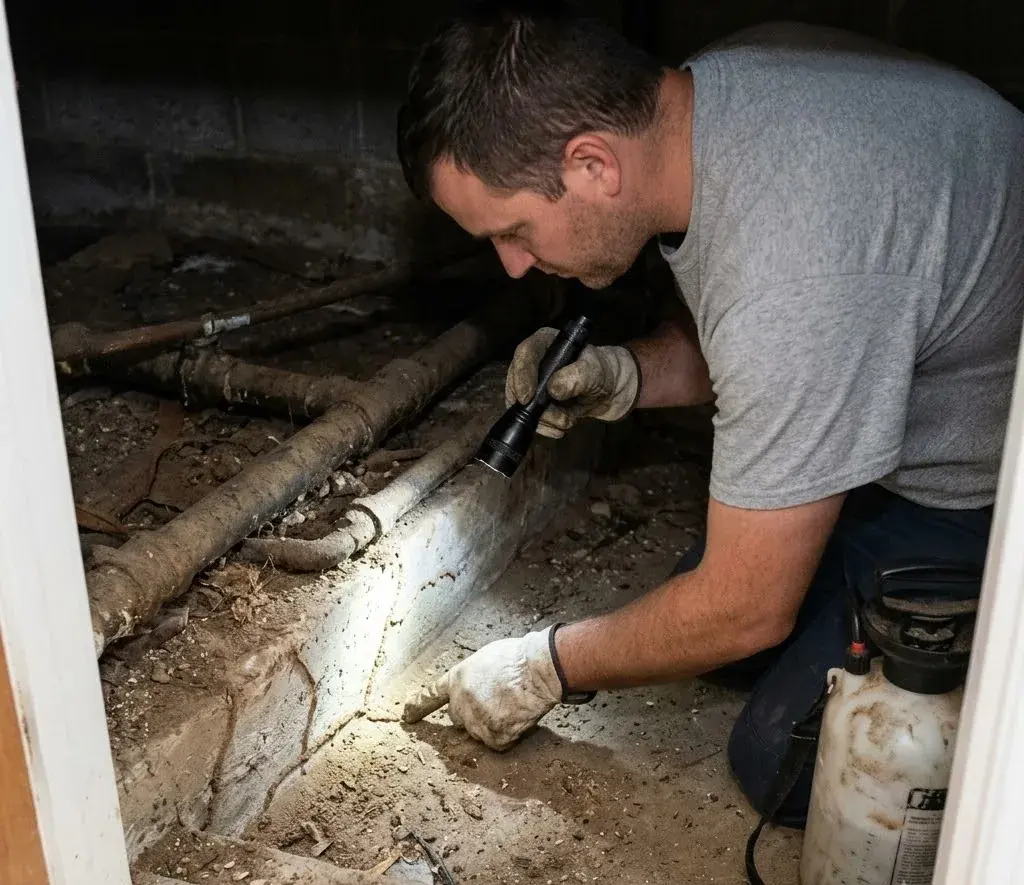
What Is Wrong With My Georgetown Home?
Most calls to this page start with a description, not a name. A thin tan scorpion under the bathroom sink. A scratching sound in the attic over Williams Drive or DB Wood Road houses at dusk. Grease marks along a baseboard near Rivery or Berry Creek. Small dark droppings on a garage shelf in Sun City or Teravista. None of that tells you the species, but it tells you where to look next, and this page is built to match what you saw to the page that explains it.
Most people do not know what pest they have, they know what they found. A pile of sawdust, a noise in a wall, a bite with nothing to show for it. This page starts from what you noticed and points at the likely cause, so you can read up on the right thing rather than guessing. If two answers look plausible, that is normal, and it is exactly what a free inspection settles.
A pile of black crickets against a lit storefront near Wolf Ranch Town Center in October is a different problem than one scorpion in a Cimarron Hills laundry room in July, and both are different from a scratching noise at roofline in an Old Town pier-and-beam house. Fire ant mounds after rain near San Gabriel Park are their own case again. Read the description that matches what you found, then follow it to the Georgetown page that covers that pest specifically.
Signs that need dealing with now
Either the problem spreads fast, there is a sting or health risk, or acting late costs a lot more.
| What you noticed | What it usually means | Read more |
|---|---|---|
| Mud Tubes on a Slab Edge | That's a native subterranean termite tube, built for cover as workers cross from soil to wood. In Georgetown these are eastern subterranean termites, and a slab edge near Wolf Ranch or Old Town is a normal place to find one, since the colony lives under the slab and travels up for moisture. Don't scrape it off and assume the problem left with it. Have the licensed pros we connect you with open it up, confirm activity, and check nearby trim and piers for hollow spots before deciding on treatment. | Eastern Subterranean Termites |
| Scorpions in the Bathtub | A scorpion in the tub almost always means it fell in overnight and cannot grip the smooth sides to climb back out, not that the bathroom is infested. It came in from outside looking for moisture, likely through a weep hole, a gap under a door, or along a slab crack opened up by dry ground. Check the tub and sink most mornings, keep the drain plugged, and have gaps around the foundation and door thresholds sealed. | Striped Bark Scorpions |
| Scorpions Under a Door Threshold | A gap under a threshold is exactly the width a striped bark scorpion needs, and finding one there usually means it came up from the slab edge outside, where dry weather has pulled the clay back from the foundation. Check the door sweep and the weep holes nearby, and expect more nearby if this is Georgetown's April-to-October season, worse in June through August. A licensed local pro can seal the gap and treat the perimeter, which matters more than any single scorpion caught inside. | Striped Bark Scorpions |
| Wasp Nests Under an Eave | A papery gray nest tucked under an eave soffit means paper wasps or red wasps, both common around Georgetown from spring onward. They favor eave overhangs, porch corners and soffit gaps because those spots stay dry and shaded. A small nest can sometimes be left alone if nobody walks near it, but one growing over a doorway, patio or AC unit gets more dangerous by the week. Do not seal the gap or spray it yourself after dark; call the licensed pros we connect you with to remove it properly. | Paper Wasps |
Signs worth booking an inspection for
Not an emergency, and not something to leave until next season either.
| What you noticed | What it usually means | Read more |
|---|---|---|
| Discarded Wings on a Windowsill | That's a swarm's leftovers, not moth dust. Native subterranean termites drop their wings right after they land, so a scatter on a Georgetown windowsill means a colony swarmed nearby, most likely after a rain between February and May. Check the sill and foundation edge for mud tubes and press on nearby trim for a hollow give. If either shows up, get a licensed local pro out before the next wet spell brings another flight. | Eastern Subterranean Termites |
| Hollow-Sounding Baseboards | Hollow baseboards usually mean termites have been feeding behind the trim, since they hollow wood while leaving the painted surface intact. In Georgetown that points to the eastern subterranean termite working up from moisture under the slab, often near a bathroom or an exterior wall. Tap along the baseboard in more than one room; if several spots sound the same, do not treat the wood yourself. Get the licensed pros we connect you with out to check the slab edge and nearby piers before it spreads further. | Eastern Subterranean Termites |
| Fire Ant Mounds After Rain | Rain gap between mounds and slab days after a storm means the colony is active near the house, and Georgetown's clay makes that gap wider once a drought breaks. Mounds within a few feet of the foundation can push workers through a slab crack looking for moisture. Treat mounds promptly, and check door thresholds and utility penetrations around the slab. | Red Imported Fire Ants |
| Ant Trails Along a Kitchen Counter | A steady line of small ants tracking the same route across a counter usually means a scout found food or water and marked the trail back to a nest nearby, often behind a wall or under a sink. Wiping the trail only breaks the scent for a while. A licensed local pro can trace the line to the nest and treat it so the ants stop coming back. | Odorous House Ants |
| Sawdust Piles Near Window Trim | Sawdust piling under a window frame in Georgetown almost always points to carpenter ants rather than termites. Termites hide their tunnels and rarely leave visible debris; carpenter ants push shavings out as they hollow a gallery. This spot usually means water has been getting behind the trim for a while, off a bad flashing or a sill that never sheds rain properly. Clear the pile, check for softness in the wood underneath, and get the moisture source found before repainting over it. | Ask on the call |
| Scratching Overhead at Night | Scratching overhead at night in Georgetown almost always means a roof rat, not a mouse on the floor below. Roof rats travel fence lines, tree limbs and power drops into the attic, so check the eaves, gable vents and any spot a branch touches the fascia near the roofline. Widespread new construction around town keeps displacing them into older, established roofs. Skip foundation traps; the licensed pros we connect you with start at the attic. | Roof Rats |
| Droppings in the Attic Insulation | Droppings scattered across attic insulation, usually along the edges near the eaves or piled where a beam crosses a soffit vent, mean a roof rat has been going in and out for a while, not just passing through. Fresh droppings are dark and soft; older ones turn gray and crumble. The fix starts at roof level: check the fascia where a tree limb reaches the house, the gable vents, and the gap over the garage, then have the entry points sealed and the attic cleared before insulation is replaced. | Roof Rats |
| Gnaw Marks on Soffit Edges | Gnaw marks on soffit edges point to roof rats, which are the rat that matters around Georgetown, not the ground-level kind. They travel fence lines, tree limbs and power drops, then chew a way in at the fascia or a gable vent because that gap is already loose enough to widen. New construction around Wolf Ranch and Teravista pushes displaced rats toward older gaps like this. Check the attic above that spot for droppings or a stained entry point, and get it closed before the opening gets bigger. | Roof Rats |
| Grease Marks Along a Wall Base | Grease marks along a wall base are rub marks left by rodents traveling the same route night after night, usually a roof rat coming down from the attic rather than anything at foundation level. Check the route back up: soffits, gable vents, and anywhere a fence line or overhead line meets the roof near Wolf Ranch or Old Town housing stock. Wipe the mark and watch whether it returns within a few days before assuming the run is still active. | House Mice |
| Roaches in the Garage at Night | Roaches moving across the garage floor at night, usually scattering when a light comes on, are most often the Turkestan cockroach, now common across Central Texas, with American and smokybrown roaches also possible in that setting. They come in through gaps under the garage door, cracks in the slab, or utility lines, drawn to moisture from a leaking spigot, a floor drain, or an irrigation box. Seal the door sweep and slab gaps, fix any standing moisture, and clear stored cardboard, since it holds both food and shelter for them. | Turkestan Cockroaches |
| Roaches Around a Kitchen Drain | This is a moisture and food problem, not a filth problem. Turkestan and American cockroaches live in drains, irrigation boxes and garages around Georgetown, and a leaking drain trap under a kitchen sink gives them both water and a way inside. Have the trap checked for a slow leak, then get the gap where the drain line enters the wall sealed. | German Cockroaches |
| Bites in a Line on Waking | Bites lined up or clustered on waking usually point to bed bugs, not mosquitoes or fleas, which bite more randomly. Check the mattress seams and headboard for tiny dark spots or shed skins. In a Georgetown home, this shows up after a move, after a guest stayed over, or after buying a used piece of furniture. Strip the bed, check the seams closely, and get a licensed local inspection before the mattress or box spring has to be replaced instead of treated. | Bed Bugs |
| Blood Spots on Bed Sheets | Blood spots on bed sheets are usually small rust-colored or dark red smears near where you sleep, sometimes with a black speck of waste nearby. They come from a bed bug being crushed after feeding, not from a cut or scratch. If you see this in a Georgetown home, Sun City unit, or a rental near Southwestern University, check the mattress seams and headboard next, and avoid moving bedding to another room, since that spreads them. | Bed Bugs |
| Dark Specks Along a Mattress Seam | Dark specks along a mattress seam are usually bed bug droppings, not dirt. Check the seam, the piping, and the tag for the same rust-colored spotting, and look for the bugs themselves in daylight along the seam edge. Bed bugs don't care whether a home is old or new, in Old Town or a newer part of Georgetown, or how clean it is. If the specks are there, treat it as bed bugs until proven otherwise and get an inspection rather than just flipping the mattress or vacuuming it. | Bed Bugs |
| Mosquitoes Biting at Dusk in the Yard | This means mosquitoes are breeding close by, likely in standing water you can reach — a clogged gutter, a saucer under a plant, a kids' pool left out. Culex quinquefasciatus, the species behind West Nile locally, bites right around dusk and breeds in exactly that kind of small container. Williamson County's mosquito traps have turned up positive results in Georgetown, including one near Geneva Park, and the county logged four human cases in 2024. Walk the yard and dump anything holding water after a rain. | Culex Mosquitoes |
| Standing Water in a Yard Drain | Standing water in a yard drain usually means the drain's slope or outlet is blocked, and it will sit there for days after any San Gabriel-area storm. That still puddle is where mosquitoes lay eggs, and it draws roof rats and roaches looking for water once the ground around Georgetown dries out again. Clear the grate, check that the outlet actually drains downhill, and if it keeps refilling with no rain, ask the licensed pros we connect you with to look at both the drain and what's breeding in it. | Culex Mosquitoes |
| Pet Scratching With No Fleas Visible | No fleas visible usually points to a tick rather than a flea, or to a skin reaction left over after fleas are already gone. Lone star ticks show up in yards near brush and tall grass around Georgetown, and a single bite can itch for days after the tick is long gone. Check between toes, around ears and the collar line with a fine comb. If scratching continues past a week, or you find ticks repeatedly, have the yard and the pet treated rather than guessing at the cause. | Fleas |
| Flea Bites Around the Ankles | Ankle bites in a straight or clustered line, small red spots with a darker center, usually appearing after time on carpet, a rug, or a shaded patio, point to fleas rather than mosquitoes. Georgetown fleas ride in on a dog or cat, or come from wildlife moving through a yard near cleared land or a greenbelt. Check pet bedding and shaded ground near the foundation. Treating just the pet does not stop it; the yard and indoor carpet need attention too, since eggs and larvae sit in both. | Fleas |
| Buzzing Inside a Wall | That hum is a colony, not a single insect, and it usually means honeybees have built a comb inside the wall void, though wasps or carpenter bees can sound similar if you put your ear to the drywall. Do not seal the opening or spray into the wall: dead bees rot in place, comb melts in Georgetown's summer heat, and honey can soak through drywall from Old Town to Teravista. Have the licensed pros we connect you with identify the species and remove the comb, not just the entrance. | Paper Wasps |
| Round Holes in Fascia Boards | Round holes in fascia boards are usually squirrels or roof rats chewing an entry into the attic, not termites, since termite damage doesn't leave open holes. Fascia at the roofline is exactly where a roof rat travels in from a fence line or a tree limb touching the house, and once one hole exists it gets reused and widened. Check nearby limbs for contact with the roof, and get the hole screened or capped once the attic is confirmed empty, or it just becomes the same entry again next season. | Ask on the call |
| A Musty Smell in a Crawl Space | A musty smell under the house usually points to moisture sitting where it shouldn't. Georgetown is slab-on-grade almost everywhere new, but Old Town and older places toward Weir and Walburg still have small crawl spaces, and that damp-basement smell means water is getting in and not drying out. It is often the first sign of a leak, poor drainage, or wood starting to break down, which also draws termites and roaches. Worth having the licensed pros we connect you with take a look before it becomes a bigger repair. | Ask on the call |
| Bulging or Blistered Wood Trim | Wood that bulges, blisters or looks bubbled under the paint is usually moisture trapped between layers, but on trim near the roofline or a fascia board it is also how termite damage first shows before the wood collapses. In Georgetown's slab construction, check window and door trim, the fascia along the roof edge, and any wood a sprinkler or gutter overflow keeps wet. Press the spot; if it gives or feels hollow, have the licensed pros we connect you with take a look before repainting over it. | Eastern Subterranean Termites |
| A Slab Crack With Insects Coming Out | A crack in the slab with ants, roaches, or other insects moving in or out means the slab has a gap running straight into the soil underneath, and something has found it. In Georgetown's clay soil, slabs shift enough season to season to open these cracks, and fire ants especially will move a colony indoors through one during a dry stretch. Caulking the crack helps, but the licensed pros we connect you with can treat the void beneath it, not just the surface. | Red Imported Fire Ants |
Signs to keep an eye on
Annoying rather than damaging. Worth understanding before you spend money on it.
| What you noticed | What it usually means | Read more |
|---|---|---|
| Crickets Piling Up at a Porch Light | This is the fall field cricket emergence, and it happens on schedule every year around Georgetown once summer starts easing into autumn. Big numbers of black crickets come out at night and gather wherever there's light — porch fixtures, garage lamps, storefronts along Austin Avenue. Switching that light off earlier in the evening, or swapping to a bulb that draws fewer insects, cuts the pile-up more than spraying does. A caulked gap under the door keeps the survivors from wandering inside once the light finally goes dark. | Ask on the call |
| Silverfish in a Bathroom | Silverfish need moisture, and a bathroom gives them what a Georgetown attic can't: steady humidity around the tub, sink, and water heater closet. Finding them there usually means condensation or a slow leak is going unnoticed, not a bigger infestation. Check under the vanity and around the water heater for dampness, run the bathroom fan longer, and fix any drip before it feeds anything else. | Ask on the call |
| Spider Webs in a Garage Corner | A web strung across a garage corner near Wolf Ranch or Berry Creek almost always belongs to a spider that moved in when new construction nearby got cleared, not to anything more serious. Sweep it down, seal gaps where the garage meets the fascia, and cut back clutter along the wall. Repeated webbing in the same spot is worth a look from the licensed pros we connect you with. | Brown Recluse Spiders |
Frequently Asked Questions
What does it mean if I see mud Tubes on a Slab Edge?
That's a native subterranean termite tube, built for cover as workers cross from soil to wood. In Georgetown these are eastern subterranean termites, and a slab edge near Wolf Ranch or Old Town is a normal place to find one, since the colony lives under the slab and travels up for moisture. Don't scrape it off and assume the problem left with it. Have the licensed pros we connect you with open it up, confirm activity, and check nearby trim and piers for hollow spots before deciding on treatment.
What does it mean if I see discarded Wings on a Windowsill?
That's a swarm's leftovers, not moth dust. Native subterranean termites drop their wings right after they land, so a scatter on a Georgetown windowsill means a colony swarmed nearby, most likely after a rain between February and May. Check the sill and foundation edge for mud tubes and press on nearby trim for a hollow give. If either shows up, get a licensed local pro out before the next wet spell brings another flight.
What does it mean if I see hollow-Sounding Baseboards?
Hollow baseboards usually mean termites have been feeding behind the trim, since they hollow wood while leaving the painted surface intact. In Georgetown that points to the eastern subterranean termite working up from moisture under the slab, often near a bathroom or an exterior wall. Tap along the baseboard in more than one room; if several spots sound the same, do not treat the wood yourself. Get the licensed pros we connect you with out to check the slab edge and nearby piers before it spreads further.
What does it mean if I see scorpions in the Bathtub?
A scorpion in the tub almost always means it fell in overnight and cannot grip the smooth sides to climb back out, not that the bathroom is infested. It came in from outside looking for moisture, likely through a weep hole, a gap under a door, or along a slab crack opened up by dry ground. Check the tub and sink most mornings, keep the drain plugged, and have gaps around the foundation and door thresholds sealed.
What does it mean if I see scorpions Under a Door Threshold?
A gap under a threshold is exactly the width a striped bark scorpion needs, and finding one there usually means it came up from the slab edge outside, where dry weather has pulled the clay back from the foundation. Check the door sweep and the weep holes nearby, and expect more nearby if this is Georgetown's April-to-October season, worse in June through August. A licensed local pro can seal the gap and treat the perimeter, which matters more than any single scorpion caught inside.
What does it mean if I see fire Ant Mounds After Rain?
Rain gap between mounds and slab days after a storm means the colony is active near the house, and Georgetown's clay makes that gap wider once a drought breaks. Mounds within a few feet of the foundation can push workers through a slab crack looking for moisture. Treat mounds promptly, and check door thresholds and utility penetrations around the slab.
What does it mean if I see ant Trails Along a Kitchen Counter?
A steady line of small ants tracking the same route across a counter usually means a scout found food or water and marked the trail back to a nest nearby, often behind a wall or under a sink. Wiping the trail only breaks the scent for a while. A licensed local pro can trace the line to the nest and treat it so the ants stop coming back.
What does it mean if I see sawdust Piles Near Window Trim?
Sawdust piling under a window frame in Georgetown almost always points to carpenter ants rather than termites. Termites hide their tunnels and rarely leave visible debris; carpenter ants push shavings out as they hollow a gallery. This spot usually means water has been getting behind the trim for a while, off a bad flashing or a sill that never sheds rain properly. Clear the pile, check for softness in the wood underneath, and get the moisture source found before repainting over it.
What does it mean if I see scratching Overhead at Night?
Scratching overhead at night in Georgetown almost always means a roof rat, not a mouse on the floor below. Roof rats travel fence lines, tree limbs and power drops into the attic, so check the eaves, gable vents and any spot a branch touches the fascia near the roofline. Widespread new construction around town keeps displacing them into older, established roofs. Skip foundation traps; the licensed pros we connect you with start at the attic.
What does it mean if I see droppings in the Attic Insulation?
Droppings scattered across attic insulation, usually along the edges near the eaves or piled where a beam crosses a soffit vent, mean a roof rat has been going in and out for a while, not just passing through. Fresh droppings are dark and soft; older ones turn gray and crumble. The fix starts at roof level: check the fascia where a tree limb reaches the house, the gable vents, and the gap over the garage, then have the entry points sealed and the attic cleared before insulation is replaced.
Not Sure What's In The Walls
Scratching in the attic at night, a mound that showed up after the last rain, a scorpion in the bathtub again — describe it plainly and we'll point you toward the page that actually matches it, rather than making you guess which service name covers your problem.
Call (866) 829-2897