Now taking calls — fast callback for urgent pest issues · (866) 829-2897
Yard & Lawn Pest Control in Georgetown, TX
Georgetown, TX

Treating the Yard Before Pests Reach the House in Georgetown, TX

Perimeter and turf pest control for Georgetown yards, covering fire ant mounds, grubs, fleas, ticks, and the barrier that keeps them out of the house

A yard in Georgetown sits on one of two very different grounds, and I-35 is the line between them. East of the highway, out toward Hutto and the Blackland Prairie, the soil is heavy clay that holds water and pushes fire ant mounds up after every rain. West of it, around Sun City and Berry Creek, the ground is thin over Edwards Plateau limestone, full of loose rock that gives ants, crickets and scorpions endless harborage. Either way, the pests that reach your door start in the turf and the mulch beds first. Getting the yard right is what keeps them out of the house.

The mild Central Texas winters do a Georgetown yard no favors. Fleas never get the hard freeze that would break their cycle, so a lawn here can carry them from one year into the next. Lone star and brown dog ticks wait in the taller grass along greenbelts and fence lines, worst on the lots that back onto a creek or a wooded stretch near the San Gabriel River. Fire ants stay busy most of the year and only slow in the coldest weeks. A yard treatment here is not a one-time summer job; it is something the ground asks for across the seasons.

Yard & Lawn Pest Control in Georgetown, TX isn't one-size-fits-all, whether you're in Cimarron Hills, Serenada, Georgetown Village, or elsewhere around Georgetown, we tailor the treatment to your property and the way fire ants behave here. That local focus is what separates a lasting fix from a temporary one.

Nearly all of this work is residential. residential pest control covers the approach for houses; commercial and multi-unit buildings are handled under commercial pest control.

Pests We Treat

  • Fire ants
  • Lawn ants
  • Grubs
  • Fleas
  • Ticks
  • Chinch bugs
  • Crickets
  • Perimeter pests
Warning Signs

Signs You May Need Yard & Lawn Pest Control

Mounds and Trails Along the Fence Line

The clearest sign is the mounds. Fire ants throw up loose domes of soil in open turf, often overnight after a Georgetown rain, and they cluster along sidewalk edges, driveways and the sunny side of the lawn. Knock one flat and it rebuilds in a day. What you see above ground is a fraction of the colony; the real nest runs deep, and a single mound can be tied to others across the yard. Treating one dome with a store spray usually just moves the colony a few feet over, which is why the whole lawn, not the mound, is the unit of the job.

Patchy, Loose Turf That Lifts Away

Fleas and ticks show up on the family before they show up in the grass. A dog that comes in from the yard scratching, or small dark specks in its coat, points back to the turf and the shaded harborage under shrubs and mulch beds. Ticks tend to grab on where the lawn meets something taller — a fence line, a greenbelt edge, the unmowed strip along a Georgetown drainage easement. If people are finding ticks after yard work or a walk near the San Gabriel River, the yard, not the woods, is usually where they got picked up.

Ticks and Fleas at the Yard's Edge

Under the surface, grubs give themselves away by the damage. Patches of turf that brown out and lift like loose carpet, or that pull up with no root holding them, usually mean grubs feeding on the roots below — and the birds, skunks and armadillos that dig the lawn up chasing them make the second sign. Come late summer, field crickets are the other tell: they pile up by the hundreds at any Georgetown porch light or garage door, then work their way to the harborage around the foundation. A yard already holding grubs and crickets is a yard feeding whatever eats them.

How It Works

Our Yard & Lawn Pest Control Process

Reading the Yard and Soil in Georgetown

The licensed pros we connect you with walk the whole yard first — fence lines, mulch beds, the damp side of the house and any woodpile — and read the soil, because the limestone west of I-35 and the Blackland Prairie east of it hold different pests. What they find sets where the treatment goes.

Treating Turf and Beds in Georgetown, TX

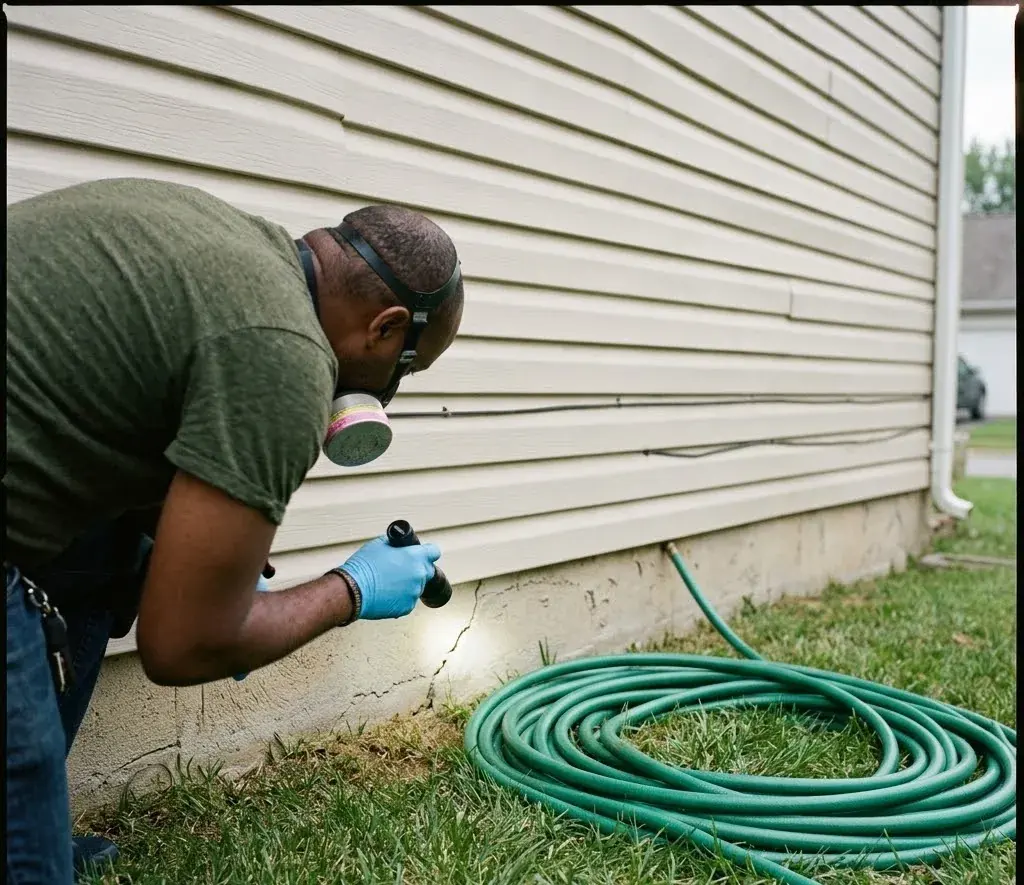
A granular product goes down across the open turf and is watered in, so it reaches grubs and fire ants at the roots. The mulch beds, the fence line and the first band of soil at the foundation get worked separately, because that harborage is where ticks, fleas and scorpions actually sit.

Setting the Perimeter Barrier in Georgetown

The base of the wall gets a barrier band, so anything crossing the yard meets it before the slab. In the older Old Town homes and out in Serenada the gaps run wider, so this step is placed with more care rather than sprayed on by rote.

Follow-Up Visits Through the Georgetown Year

Central Texas runs warm most of the year, so one round rarely holds. Follow-up visits catch the next fire ant mounds, the fall cricket wave and the flea larvae that hatch after the first pass. The schedule bends to the yard, not to a fixed calendar.

Why this matters

Nearly every house in Georgetown sits on a concrete slab, and that shapes how yard pests get inside. There is no crawl space to stop them and no basement to fall into — the living floor meets the ground at the slab edge, so anything crossing the last few feet of turf is already at the threshold. Ants follow the slab's expansion joints, crickets and scorpions come through weep holes and under doors, and fleas ride in on a pet. That is why the yard and the perimeter are the real defense here: on a slab, the outside wall is the only line between the lawn and the living room.

Licensing & Local Standards

Code-Compliant Yard & Lawn Pest Control in Texas

Two Soils, Split by I-35

The two soils around Georgetown ask for two different approaches. On the Blackland clay east of I-35, water sits and mounds spread, so the fire ant work leans on a granular bait broadcast across the whole lawn and watered in, letting the colony carry it down to the queen. On the thin, rocky Edwards Plateau ground on the west side, the loose limestone gives so much harborage that the perimeter around the foundation and the mulch beds matters as much as the open turf. The licensed pros we connect you with read the ground first and treat it for what it is.

Licensed for Lawn and Ornamental Work

A perimeter barrier is the band that separates the yard from the house. The idea is a treated strip a few feet out and a few feet up the foundation of a Georgetown home, across the weep holes, door thresholds and the mulch that runs against the wall, so ants, crickets, fleas and the odd scorpion meet it before they find a way in. It works best paired with the yard work behind it — trimming shrubs off the wall, pulling mulch back from the foundation, cutting the harborage down — because a barrier holds longest when the yard on the far side of it is not sending a constant supply of pests at it.

Local Cost Factors

What Drives Pest Control Costs Here

Pricing in Georgetown depends on what you're dealing with. A one-time scorpion treatment along a Sun City or Cimarron Hills foundation costs less than an ongoing roof rat job that needs attic and eave work.

Get an Exact Number, Not a Guess
Fire AntsScorpionsRoof Rats
One-Time what actually gets into Georgetown homes near Sun City and Berry Creek an estimated $65–$175
Quarterly Scorpion, fire ant and roof rat control for Georgetown homes on both sides of I-35 an estimated $80–$255
Bi-Monthly Scorpion Entry Points Around Georgetown Homes on Limestone and Caliche Ground an estimated $120–$405
Monthly Roof rat entry points and attic nesting signs for slab-on-grade homes near Wolf Ranch an estimated $190–$675

Ground matters more than square footage on the west side of I-35. A house in Sun City or Cimarron Hills sitting over the Edwards limestone often needs extra attention at slab cracks and weep holes where scorpions get in, which can add a modest line to an otherwise ordinary estimate. East toward Rivery or the Blackland Prairie side, that line usually isn't there.

Questions & Answers

Frequently Asked Questions

How soon after treatment can my kids and dog use the yard?

Because the winters here rarely bring a hard freeze, yard pests in Georgetown stay active across most of the year, so a single summer treatment does not hold. Most yards do best on a recurring schedule — a heavier round in spring as fire ants and fleas ramp up, then follow-ups through the warm months into fall. Fire ant bait in particular has to be reapplied as new colonies move in from a neighbor's lot or an open field. The right interval depends on your soil, how much of the lot backs onto a greenbelt, and how bad last season was.

Will one treatment get rid of the fire ant mounds for good?

No treatment clears fire ants permanently, and anyone in Georgetown who promises that is overselling it. Colonies re-enter from open ground, roadsides and neighboring lots, especially out on the newer Blackland prairie developments east of I-35 where there is a lot of open field nearby. A broadcast bait taken down to the queen can knock a lawn's mounds out for a season, but the goal is control kept up over time, not a one-time cure. Expect to see new mounds after heavy rain and to treat again rather than assume the problem is gone.

Does treating the yard help with scorpions getting inside?

Fire ants are the yard problem most Georgetown homeowners want handled first. The heavier Blackland Prairie soil east of I-35, out toward Hutto and around Katy Crossing, holds moisture and builds visible mounds fast after rain. Spot-treating a single mound just moves the colony a few feet, so the licensed pros we connect you with usually broadcast a granular bait across the whole turf so foragers carry it back, then treat mounds directly for anything active. On a typical Georgetown lot that keeps the lawn clear through the warm months, when the ants are working hardest.

How often does a lawn in Georgetown need treating?

Fleas and ticks live in the yard long before they reach the house. Lone star ticks and brown dog ticks wait in taller grass and along shaded fence lines, and because Georgetown winters rarely stay cold enough to break the cycle, fleas run more or less year-round here. The work concentrates on harborage: the shady, humid strips under shrubs, along mulch beds, and where turf meets a greenbelt in places like Berry Creek or the wooded lots near the San Gabriel River. Mowing, thinning leaf litter, and a targeted treatment of those edges does more than blanketing open lawn that dries out in the sun.

Can you treat fleas and ticks without spraying the whole lawn?

Not always the same visit. Perimeter granular treatments target ants, fleas and ticks living in turf and mulch beds, while fire ant mounds often need a direct mound treatment on top of the barrier application. If Bermuda or St. Augustine turf is thick, the pros we connect you with may pull back mulch near the foundation first so the granular product reaches the soil instead of sitting on top of harborage material. Ask at booking whether your yard needs both.

What can I do about the fall crickets swarming my porch light?

It might be grubs, but brown patches in a Georgetown lawn can be several things — drought stress on the thin soil west of town, a fungal disease, or a dog. The grub tell is turf that lifts easily because the roots have been chewed off underneath, often with birds, skunks or armadillos digging it up to eat them. Peel back a square foot of a bad patch and look: white, C-shaped larvae in the top few inches of soil point to grubs. If the roots are intact and holding, the cause is probably watering or disease, not insects, and a grub treatment would not fix it.

How much does yard & lawn pest control cost in Georgetown?

Roof rats explain why an attic inspection near Wolf Ranch or Teravista starts at the roofline, not the foundation. They travel fence lines and power drops into soffits and gable vents, so the fix looks upward. Fall field crickets are simpler: they swarm porch lights and shop fronts along Williams Drive and Austin Avenue every autumn, and turning a light off does more than any treatment. Georgetown's pest calendar runs on these patterns more than on the calendar month.

Local Conditions

Where Scorpions Get Inside

Why field crickets swarm porch lights around Georgetown every fall without warning

DIY vs Pro Pest Control in Georgetown, TX
DIY vs Pro

DIY vs Pro Pest Control in Georgetown, TX

Store-bought bait and spray handle some Georgetown pest problems and miss others completely. Here's a plain look at what over-the-counter products can actually do, what they cost over a year, and which jobs — a scorpion problem tracing back to a limestone yard, a termite swarm off a slab — are never really a homeowner job.

Read article
Signs You Need Pest Control in Georgetown
Pest Warning Signs

Signs You Need Pest Control in Georgetown

Most pests around a Georgetown house are a nuisance you can live with for a while. This post walks through the handful of signs that mean it is time to stop waiting and call a licensed pro instead.

Read article
What Attracts Pests to Homes in Georgetown, TX
Home & Yard

What Attracts Pests to Homes in Georgetown, TX

A walk around a Georgetown house explains most infestations before a single pest is named: food left out, water sitting somewhere it shouldn't, and a gap that was never meant to be an entry point. This post goes room to room and yard to yard through what actually draws pests in.

Read article
Get Started Today

Ready To Book A Visit

Whether it is a single scorpion sighting in Berry Creek or a rat that has been in the attic all summer near Wolf Ranch, the next step is the same: call and describe it. The licensed pros we connect you with will take it from there.

Call (866) 829-2897
Free inspections & same-day service available
Call (866) 829-2897 Schedule Online