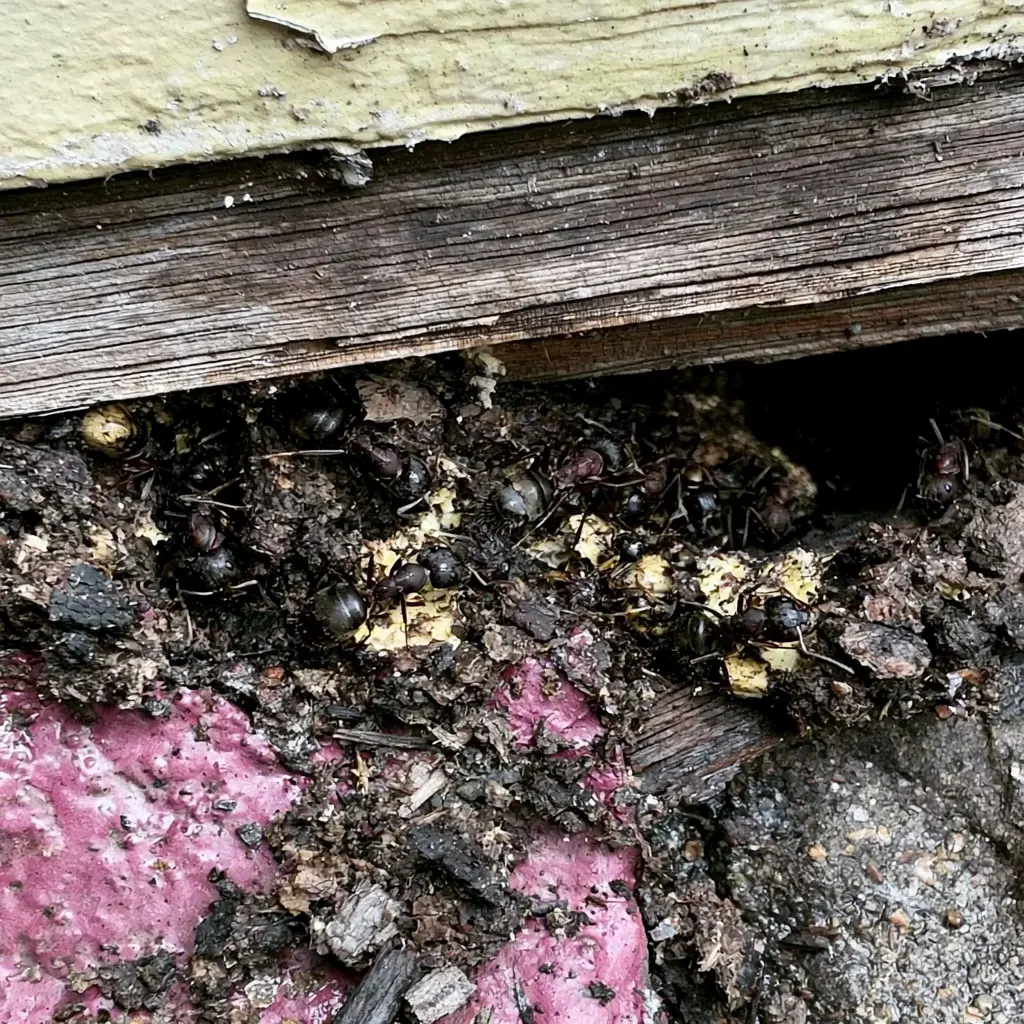
Termite Inspections in a Georgetown Home Sale
What happens when a termite report turns up during a Georgetown home sale, and who ends up dealing with it.
A termite inspection for a Georgetown home sale is a separate, licensed check ordered under the purchase contract, usually paid for by the buyer, that produces the state's official report. Lenders want it before closing. If it finds active termites, the buyer and seller typically negotiate who pays for treatment before the sale can close.
When the Report Fits Into Closing
A termite inspection tied to a house sale in Georgetown almost never happens on its own timeline. It gets triggered by the contract: once a buyer and seller have a signed agreement, the buyer's lender or the buyer's own due diligence calls for a wood-destroying-insect report, and somebody has to schedule it before the file can move toward closing. The inspector is looking at the same slab-on-grade foundation that most of this town sits on, but the report they hand back is being read by people who have never seen the house — a loan officer, an escrow officer, sometimes an attorney.
Most Georgetown contracts leave the option period as the natural window for this. A buyer under contract on a place in Berry Creek or Teravista will usually have the termite inspection done alongside the general home inspection, while there is still time to negotiate or walk away without losing the option money. Waiting until closer to closing narrows that room to nothing, because a finding at that stage still has to be dealt with before the lender will fund, and there is no longer any slack in the calendar to argue about it.
Georgetown adds a wrinkle most buyers do not expect: this county has both very new construction and very old housing, sometimes on the same street. A slab poured in Wolf Ranch or Sun City in the last decade behaves differently under inspection than a pier-and-beam place near Old Town and the Square. Termites do not care which one they are in, and eastern subterranean termites are established across this part of Texas regardless of a house's age, but an older foundation gives an inspector more places to look and more reason to flag conducive conditions even when no live activity turns up.
Who Pays and What Lenders Expect
Who pays for the inspection is a matter of negotiation, not a fixed rule. Texas contracts leave it open, and in practice it gets settled the same way most closing costs do — written into the contract up front, or traded during option-period negotiations along with who covers any treatment a finding calls for. A seller who already knows their house has had termite activity will sometimes order and pay for the report themselves, before the property even goes on the market, so there are no surprises once a buyer's option period starts running.
Lenders care about this report because a termite problem is a property-value problem, not just a pest problem. A VA loan requires a wood-destroying-insect inspection as a condition of the loan in most cases, and the report has to come from a Texas-licensed technician or certified applicator working in the termite category — nobody else's signature satisfies a lender. Conventional and FHA lenders vary in how strictly they require it, but once a report exists and shows active infestation or damage, almost any lender will want to see it resolved, or at least priced into the deal, before they will fund.
What a lender is actually reading for is whether the finding threatens the structure or is just a maintenance item. Active termites in a bathroom sill plate near a leak reads differently than an old, dry mud tube on an exterior pier with no current activity. Wood-to-soil contact, debris against the foundation, or a drainage problem pushing water against the slab all count as conducive conditions rather than damage, and a lender is far less likely to hold up a closing over those than over live termites or rotted framing.
When the Report Enters a Georgetown Sale
When a Georgetown report comes back with a finding, the buyer and seller are negotiating over three different things that often get treated as one: the pest itself, the damage it left, and the conditions that let it in. Getting rid of active termites is usually the smallest of the three. Repairing wood damage discovered under a bathroom or along a rim joist can cost far more than the treatment, and fixing a conducive condition — regrading a flower bed piled against the siding, moving a sprinkler head that has been soaking the same corner of the slab for years — is its own line item again.
The usual paths are a repair credit at closing, a price reduction, or the seller arranging and paying for the work themselves before the buyer takes possession. Which one makes sense depends on timing: a treatment can often be scheduled and finished inside a normal option period, while structural repair to damaged framing sometimes cannot, and a buyer's lender may not want to close on a house with open repair work at all. A seller who pushes back on every finding risks losing the buyer; a buyer who tries to renegotiate every conducive condition on an otherwise sound Georgetown house risks losing the seller's patience along with the contract.
Whatever gets agreed goes through escrow, not as a handshake. A repair credit is written into the closing figures the title company prepares, and if the seller is doing the work themselves, most contracts call for proof — an invoice, a warranty, sometimes the treating company's own paperwork — before the funds move. Verbal promises to "take care of it after closing" are the one arrangement that consistently causes trouble, because once the deed is filed there is very little left to negotiate with.
- Report requested by the lender or buyer early in the option period, before earnest money becomes non-refundable
- Buyer usually pays for the inspection, though this is often negotiated in the contract before closing
- Active infestation or damage found triggers negotiation over treatment cost, repair, or a price reduction
- Seller-paid treatment may require a re-inspection and updated report before the lender will clear the file
- Report is generally treated as valid for a limited window, so timing it close to closing matters
- Repairs to wood-to-soil contact or moisture issues are often required before the lender releases funds at closing
Who Actually Pays for the Report
If a treatment or repair was part of the deal, most buyers and their lenders want proof it actually happened before money changes hands — that is the re-inspection. It is a shorter visit than the original inspection: the technician goes back to the specific area that was flagged, confirms the treatment was applied or the repair was completed, and issues a follow-up document rather than redoing the whole report. Skipping this step and taking a seller's word for it is how a buyer in Georgetown Village or Katy Crossing ends up closing on a house where the mud tubes were painted over rather than treated.
A clean re-inspection is what produces a clearance — the paperwork a lender or title company will accept as proof the issue is resolved. It is not a guarantee against future termite activity; it says the condition found at the time of the original report has been addressed. Buyers sometimes confuse a clearance with a warranty against termites coming back, which it is not, and sellers sometimes treat it as the end of their obligation on the house even when a related repair, like fixing the drainage that caused the moisture in the first place, was never actually finished.
| Scenario | Who Pays | Why |
|---|---|---|
| Report ordered | Buyer, per contract terms | Sets the baseline before closing moves forward |
| Active termites found | Buyer and seller negotiate | Treatment or repair usually required first |
| No findings on report | Buyer and seller negotiate who pays before closing | Satisfies the lender's requirement, sale proceeds |
| Treatment completed | Party named in contract | Re-inspection confirms it before closing |
| Report nearing expiry | Buyer or lender | A fresh report may be requested |
When the Inspector Finds Active Termites
Timing between the report and the closing date matters more in a fast-moving contract than most buyers expect. A report that sat on file for weeks while financing dragged on may no longer reflect current conditions, especially after Central Texas gets one of its heavy rain events — the kind that has flooded the San Gabriel River corridor before — which can change moisture conditions around a foundation in days. Lenders and title companies generally want the report dated close to the closing itself for exactly that reason, and a buyer whose closing keeps slipping should ask whether the report needs to be redone rather than assume the original one still holds.
The practical order that works in most Georgetown transactions is: inspection during the option period, any negotiation settled and written into the contract while there is still room to walk away, treatment or repairs scheduled early enough to allow for a re-inspection, and the clearance in hand before the closing date rather than promised after it. Buyers closing on a purchase near Southwestern University or out toward Sun City run into the same sequence regardless of neighborhood — what changes is how much lead time a treatment or repair needs, not whether the order matters.
Re-Inspection and the Clearance Letter
None of this requires a buyer or seller to become an expert in termite biology — it requires picking a licensed pro who understands both the pest and the transaction, and getting everything in writing early enough that it can still be negotiated. The licensed pros we connect you with in Georgetown handle this kind of inspection and re-inspection regularly, and know what a Williamson County lender or title company expects to see before they will let a closing go forward.
A re-inspection is not automatic. If the first report flagged an active infestation, the licensed technician or certified applicator who did the treatment typically returns afterward to confirm the activity has stopped and to issue an updated report the closing table can rely on. Some Georgetown buyers ask for this in writing as a condition of the contract rather than taking a verbal assurance that the work is finished; with closings often stacked back to back in a fast-growing market, a second visit that never gets scheduled is the most common way this step slips.
How Long the Report Holds Up in Escrow
Once a report comes back with findings, the conversation moves from inspection to negotiation. The buyer and seller, through their agents, work out who pays for treatment, whether any wood damage gets repaired before closing or credited at the table, and how much time that adds to the schedule. None of this is set by the state; the report states what was found, not who is responsible for fixing it, so the contract language carries the weight.
In practice, most Georgetown deals settle on one of three outcomes: the seller pays for treatment and repair before closing, the price is reduced to cover it, or funds are held back in escrow until the work is done and a re-inspection confirms it. With the county still absorbing new residents every year and closings often tight on timing, a buyer moving from Round Rock or Austin into a resale near Old Town or Serenada is usually better served by a firm closing date with a holdback than an open-ended promise to fix it later.
Fast Facts Before You Sign
- Requested during the option period, before earnest money is at risk
- Buyer typically pays, though the contract can shift this to the seller
- Eastern subterranean termites are the species behind almost every Georgetown finding. They swarm in daylight after rain, most often between February and May.
- Findings can delay closing until repair or re-inspection is complete
- Lenders in Georgetown commonly require the report before final approval
- Report is on form SPCS/T-5, signed by a licensed technician
Frequently Asked Questions
Who pays for the termite inspection when buying a Georgetown house?
Texas does not set who pays. It is negotiated into the purchase contract like any other cost, and in Georgetown it is most often the buyer, arranged during the option period. Some sellers cover it to keep a sale moving, particularly in neighborhoods like Wolf Ranch or Teravista where competing offers are common. Whoever pays, the inspection itself has to be done by a technician or certified applicator licensed in the termite category, and the result goes on the Texas Official Wood Destroying Insect Report.
What happens if the termite report finds active termites before closing?
In Georgetown, who pays for the termite inspection is usually settled in the contract, not by any rule — it's a negotiating point like the survey or the option fee. Sellers in older Old Town homes near the Square often cover it up front, since the age of the housing stock makes lenders more likely to ask for one. Out in newer subdivisions like Teravista or Berry Creek, buyers frequently order it themselves during the option period, then bring it back to the negotiating table if the report turns up active termites or damage worth repairing before closing.
How long is a Georgetown termite report good for?
The report notes what was found — active termites, old damage, or a conducive condition such as wood-to-soil contact — and the sale does not fail because of it. The buyer and seller negotiate who pays for treatment and any repair, often through the same option period that got the inspection ordered in the first place. Eastern subterranean termites are the ones that turn up here, and treatment is routine; it is not a reason on its own to walk away from a house in Berry Creek or Sun City.
Can a seller refuse to treat termites found during the sale?
Not automatically. It depends on the lender and the loan type, not on a countywide rule. Some lenders ask for a Texas Official Wood Destroying Insect Report on any slab foundation, which covers most of Georgetown; others never mention it. The only way to know is to ask the lender directly early in the process, rather than assuming it will or will not be required.
Does the lender require a termite inspection to close on a Georgetown home?
Yes. A termite report showing active infestation or damage is the moment for negotiation, not a deal-breaker on its own. Buyers on the west side around Sun City or Wolf Ranch, where limestone ground pushes moisture and pests up against the slab edge, sometimes see a specific dollar credit written into the contract instead of insisting the seller schedule treatment before closing. Whichever way it's handled, ask for a re-inspection and a fresh clearance letter close to closing — a report that's a few months old may not satisfy the lender.
Closing on a Georgetown House Soon?
Buying near Sun City or selling an Old Town property, get the termite report scheduled early so treatment and re-inspection don't hold up your closing date.
Call (866) 829-2897