Georgetown gets a flurry of these questions every spring, usually after a warm rain, when a windowsill fills with what looks like a handful of shed wings. Termite swarmers and flying ant swarmers get confused constantly because both fly, both shed those wings, and both show up around the same wet weeks between February and May. The differences are small but they hold up under a hand lens: waist, wing shape, antennae. Look before you clean up, because what you do with the specimen matters more than how fast you get rid of it. This is the identification, not the treatment — that decision comes after you know which one you found.
Start With the Waist
Waist first, because it is the fastest tell. An ant has a narrow, pinched waist between the thorax and the abdomen, visible even at a glance if the insect is still in one piece. A termite swarmer has no waist at all — its body runs in a straight, even line from front to back, closer to a grain of rice than a figure eight. Antennae are next: an ant's antennae bend sharply, almost at a right angle, like a slender elbow. A termite's antennae are straight, or close to it, running out from the head like two short, even threads with no obvious bend.
Check the Wings
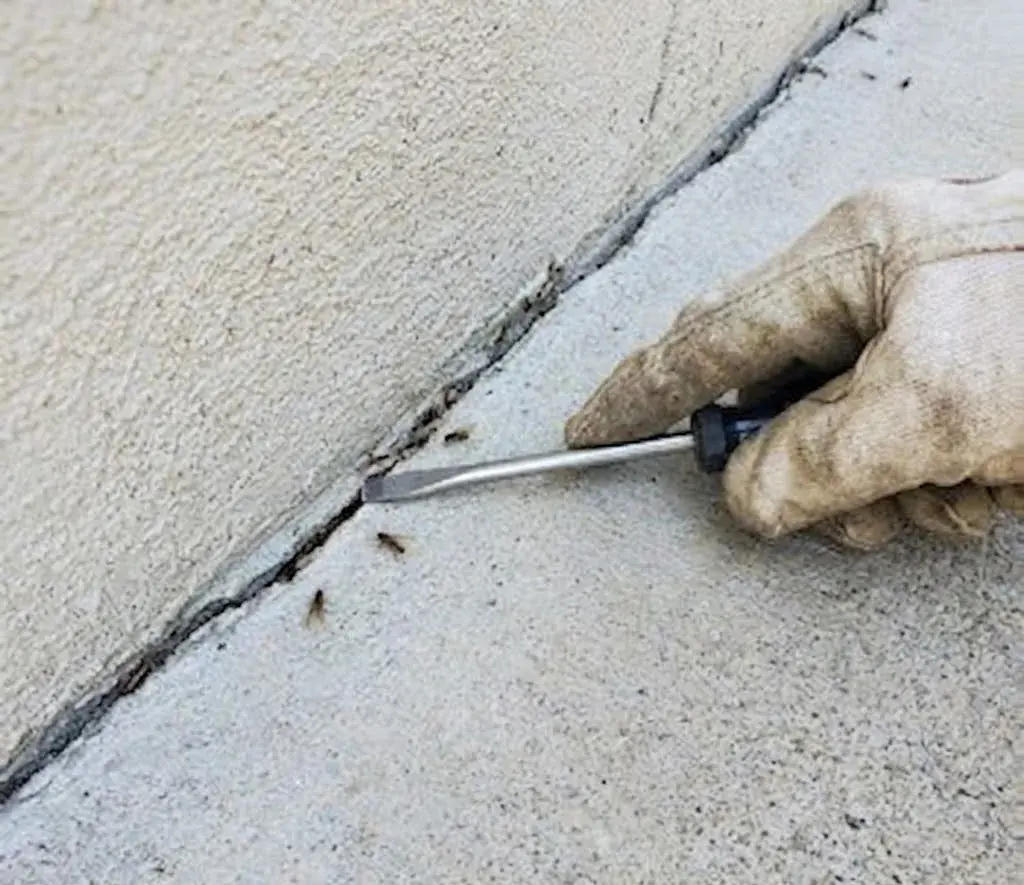
Wings settle it if the waist and antennae are hard to judge on a small or damaged specimen. A flying ant has two pairs of wings, and the front pair is noticeably longer than the back pair — the difference is easy to see side by side. A termite swarmer also has two pairs of wings, but all four are the same length and the same shape, giving the insect a symmetrical, almost paper-airplane look at rest. Termite swarmer wings also detach easily, which is why a cluster of identical, evenly sized wings with no bodies attached, left on a sill or a slab edge, is itself a strong sign of a termite swarm rather than ants.
When Georgetown Swarms Happen
In Central Texas, native subterranean termites swarm during the day after a warm rain, most commonly between February and May, with activity tending to start earlier here than it does further north. Flying ants are not tied to that same window in the same way and can show up across more of the year. So timing helps but should not stand alone — a windowsill full of even-length-winged, waistless, straight-antennaed insects in March near a slab edge in Wolf Ranch or Teravista is worth treating seriously regardless of the exact date. Drought years do not make termites less likely; the colony is following moisture, and that moisture is usually sitting under the slab where it cannot be seen from the yard.
Keep the Specimen
If a swarm turns up, the single most useful thing to do is keep a specimen rather than clean it away. A few insects and a few of the discarded wings, sealed in a small jar or a sandwich bag, let a licensed applicator identify the species with certainty instead of guessing from a description over the phone. Vacuuming up the evidence, or wiping down the sill before anyone looks at it, removes the one thing that makes a fast, accurate call possible. This page is only about telling the two apart — anyone who has confirmed a termite swarm rather than an ant one is better served by the site's termite pages for what happens next, not by treatment details folded in here.
Dealing with this in your home?
Georgetown posts start the same way, and it always shows: a scorpion crossed the tile at midnight, a fire ant mound came up overnight off Williams Drive, something is moving in the attic above Berry Creek. This page pulls those threads apart one at a time — what the striped bark scorpion actually wants, why roof rats never touch your slab, why the San Gabriel doesn't explain the ants. By the end you'll know which of those calls can wait until morning.