A carpenter ant colony in a Georgetown house is a moisture problem wearing an insect costume. The ants themselves don't eat wood the way a termite does — they chew it out to make room, smoothing tunnels called galleries through anything soft enough to work. Wood only gets soft enough once it's already wet, so a trail of carpenter ants across a kitchen counter is usually the second sign of a leak, not the first. The first sign was probably a stain nobody looked at closely. Georgetown's mix of older Old Town homes and newer slab construction both produce this same soft spot eventually, just from different plumbing.
Finding the Actual Nest
Spraying the visible trail kills the ants you can see and does nothing about the ones you cannot. Carpenter ant colonies split into a parent colony and one or more satellites, and the satellite is usually what shows up on a kitchen counter, nowhere near the actual nest. Killing that trail scatters the workers, breaks the scent line back to the nest, and leaves the moisture problem that started this untouched. A bait that workers carry home to the colony, or a professional found the nest and treated it directly, is what actually ends the problem. Georgetown homes with a leaking shower pan or bad window flashing near Southwestern University or out toward Berry Creek are the ones that see this pattern repeat.
Reading the Frass
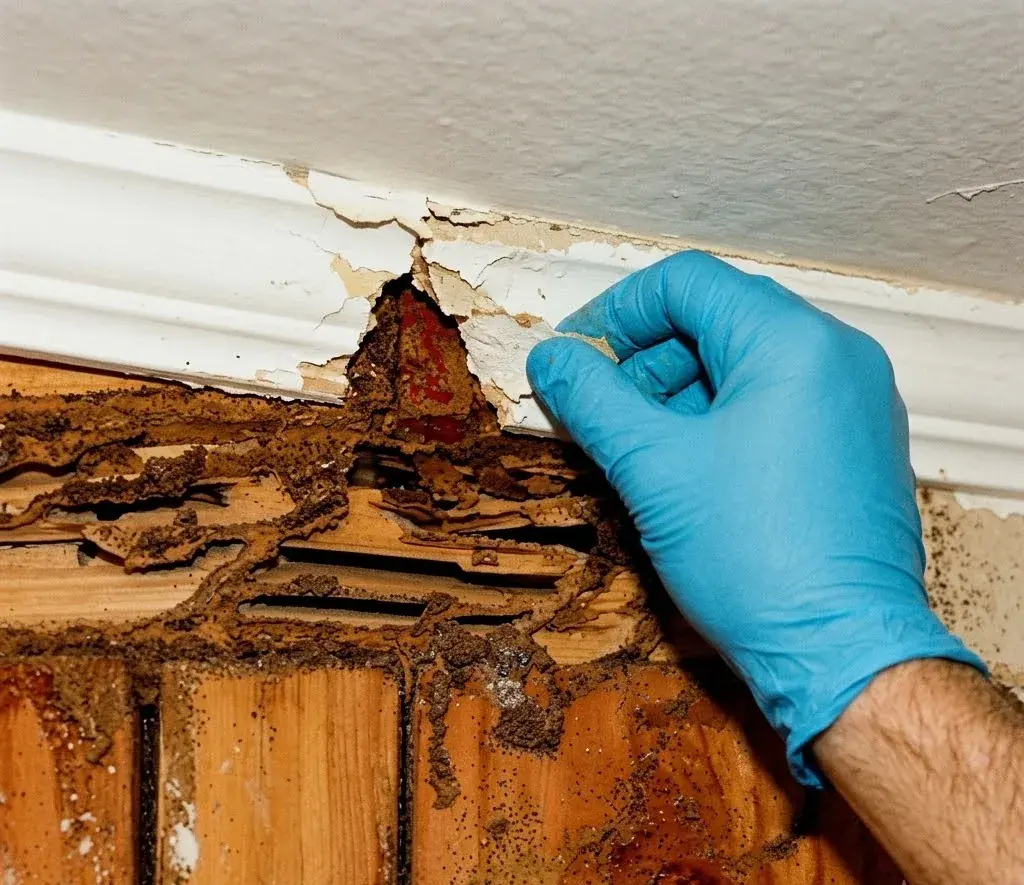
Carpenter ants push debris out of their galleries as they excavate, and that debris is called frass — a coarse, fibrous material, sometimes with bits of dead ants or insect parts mixed through, that piles up in a small heap below a kick-out hole in the wood. Frass is the single best clue to where a nest actually is, better than the ants themselves, because it doesn't wander. A pile of it on a windowsill near Wolf Ranch or Berry Creek or anywhere else in Georgetown means there's a kick-out hole directly above it, and that hole leads to a gallery worth opening up. No frass, just ants walking a wall or countertop, usually means you're watching a foraging trail headed somewhere else in the house.
Why Spraying the Trail Backfires
Spraying the ants you can see along a trail feels like doing something, and it's close to the worst move available. A contact spray kills the workers in front of you and leaves a residue the rest of the colony can smell and avoid, so the colony simply reroutes around the dead zone and keeps foraging from the same nest, undisturbed. Worse, if the spray reaches a healthy colony under stress, some species will bud off new satellite nests in response, turning one problem into several scattered through the house. The trail is information, not a target. Left alone for a day or two, it tells you which direction to search; sprayed, it tells you nothing and the ants just find a new route.
What Actually Works
Bait, not spray, is what actually clears a carpenter ant problem, because bait relies on the same foraging behavior that makes spraying pointless. Workers carry bait back to the nest and feed it to the rest of the colony, including the queen, so it reaches the parent colony wherever it's actually hidden — a shower wall, a rotted sill, somewhere no one would think to spray. That still leaves the moisture problem sitting there afterward. Bait can knock a colony down, but if the leak under a Sun City bathroom or a Georgetown Village window frame never gets fixed, the wood stays soft and another colony eventually finds it. The lasting fix is drying out the wood, and the licensed pros we connect you with can trace the moisture back to its source as part of clearing the ants.
Dealing with this in your home?
Georgetown posts start the same way, and it always shows: a scorpion crossed the tile at midnight, a fire ant mound came up overnight off Williams Drive, something is moving in the attic above Berry Creek. This page pulls those threads apart one at a time — what the striped bark scorpion actually wants, why roof rats never touch your slab, why the San Gabriel doesn't explain the ants. By the end you'll know which of those calls can wait until morning.