Ants show up in Georgetown kitchens and bathrooms every spring, and the timing is not random. A colony that has spent the cold months underground or tucked into a wall void starts foraging again once the soil warms, and the trails that show up along a baseboard or across a countertop are worker ants following a scent path back to whatever fed the colony last. Add in a wet week off the San Gabriel River and the pattern gets stronger, because rain pushes ants up out of the ground and toward anything dry. None of this means the house did something wrong. It means the season turned, and the ants noticed before the calendar did.
Reading a Trail Back to Its Source
A trail is not random wandering. Ants that have found food lay down a scent path as they walk, and every ant behind them follows that same path rather than searching on its own. Look at a line of ants on a counter in Old Town or a newer kitchen out toward Teravista and it almost always leads two directions: back to a gap they came in through, and forward to whatever drew them in, usually something sugary or greasy left uncovered overnight. Following the trail backward to the entry point, rather than just wiping up the ants you can see, is the only way to understand what is actually happening instead of guessing at it.
Why Moisture Pulls Ants Toward the House
Moisture is doing more work here than most people assume. Georgetown sits on ground that does not drain straight down — west of I-35 it is limestone with fractures that move water sideways, and even east of the highway a hard spring rain leaves damp spots around a foundation or a leaking hose bib for days. Ants forage toward that moisture the same way they forage toward food, so a wet season after a dry stretch often looks like an ant problem appearing out of nowhere. It usually is not new. The colony was already nearby; the rain just gave it a reason to move closer to the house.
Swarmers: Telling Ants From Termites
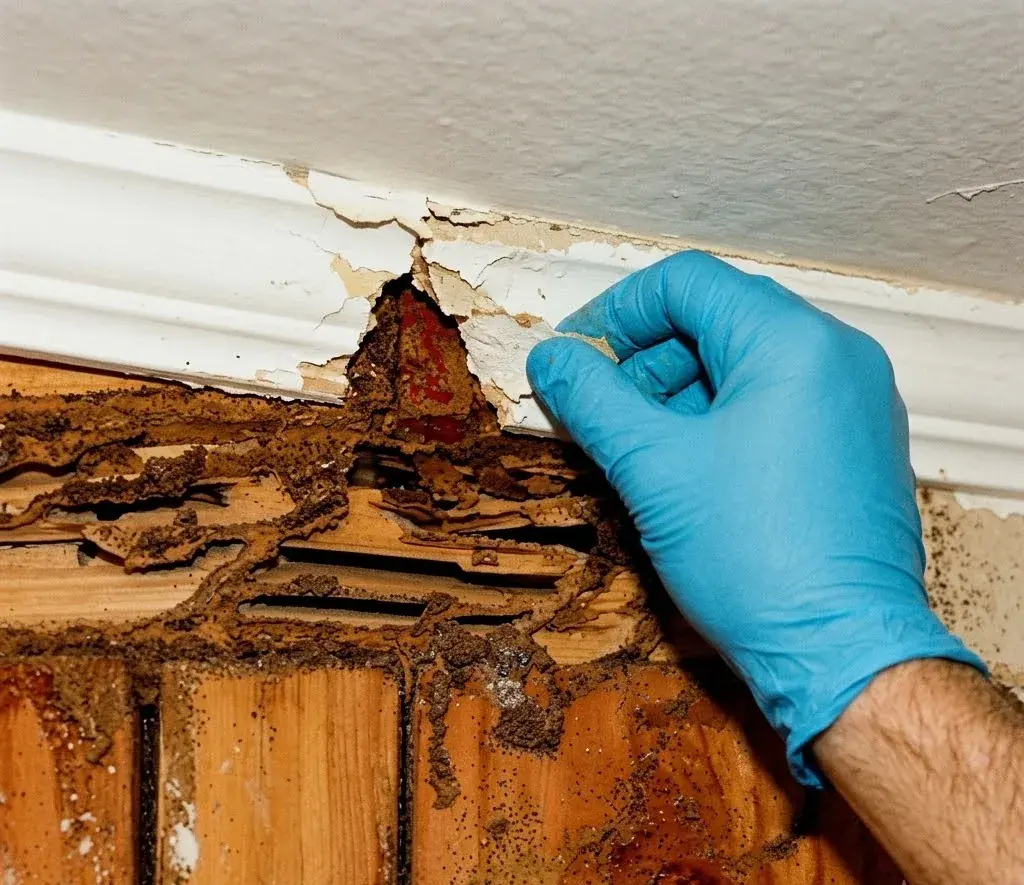
Spring is also when a mature colony sends out swarmers, winged reproductive ants leaving to start new colonies elsewhere. Seeing a cluster of winged ants near a window or door in Georgetown in spring does not automatically mean termites, and it is worth telling the two apart rather than assuming the worse case. Ant swarmers have a pinched waist and uneven wing lengths; termite swarmers have a straight waist and wings the same length as each other, and native subterranean termites here tend to swarm after rain in the February-to-May window. If the insects are indoors and clearly ants, it usually points to a colony already established inside a wall or under a slab edge, not a new invasion from outside.
What Actually Slows a Spring Colony Down
If a trail keeps showing up in the same spot, that line is worth reading rather than just wiping down. Ants mark the path with a scent trail, and the workers on it are running both directions between the nest and whatever food source they have found, so the trail thins out toward the source and thickens back toward the colony. Follow it backward past the counter edge, along the baseboard, and toward the point it disappears into a wall gap, a slab crack, or a door threshold. That entry point, not the ants standing on the counter, is what a homeowner or the licensed pros we connect you with actually needs to find before bait does any good, since bait set away from the real trail mostly gets ignored.
Dealing with this in your home?
Georgetown posts start the same way, and it always shows: a scorpion crossed the tile at midnight, a fire ant mound came up overnight off Williams Drive, something is moving in the attic above Berry Creek. This page pulls those threads apart one at a time — what the striped bark scorpion actually wants, why roof rats never touch your slab, why the San Gabriel doesn't explain the ants. By the end you'll know which of those calls can wait until morning.