People ask this after seeing mud tubes on a pier, or after a neighbor mentions a treatment bill. The short answer is yes, termites are a normal part of owning a house in this part of Williamson County, and the pressure is steady rather than rare. The termite involved is the eastern subterranean termite, a native species that lives in soil colonies and has been working through Central Texas long before any subdivision existed. It is not a coastal or eastern-state problem imported here. It is the termite that was already in the ground when the slab went down.
Why the Soil Matters
Georgetown sits in the range of the eastern subterranean termite, and that colony lives in the soil, not in the wood it eventually reaches. Around Wolf Ranch and out toward Teravista the slabs are newer, but a young slab does not mean a termite-free lot, since the insects were already working that ground before the foundation went in. West of I-35, where the limestone runs thin over caliche near Cimarron Hills and Water Oak, water moves sideways through old fractures instead of draining straight down, which keeps soil damp in patches even in a dry year and gives a colony somewhere reliable to stay.
What a Swarm Looks Like Here
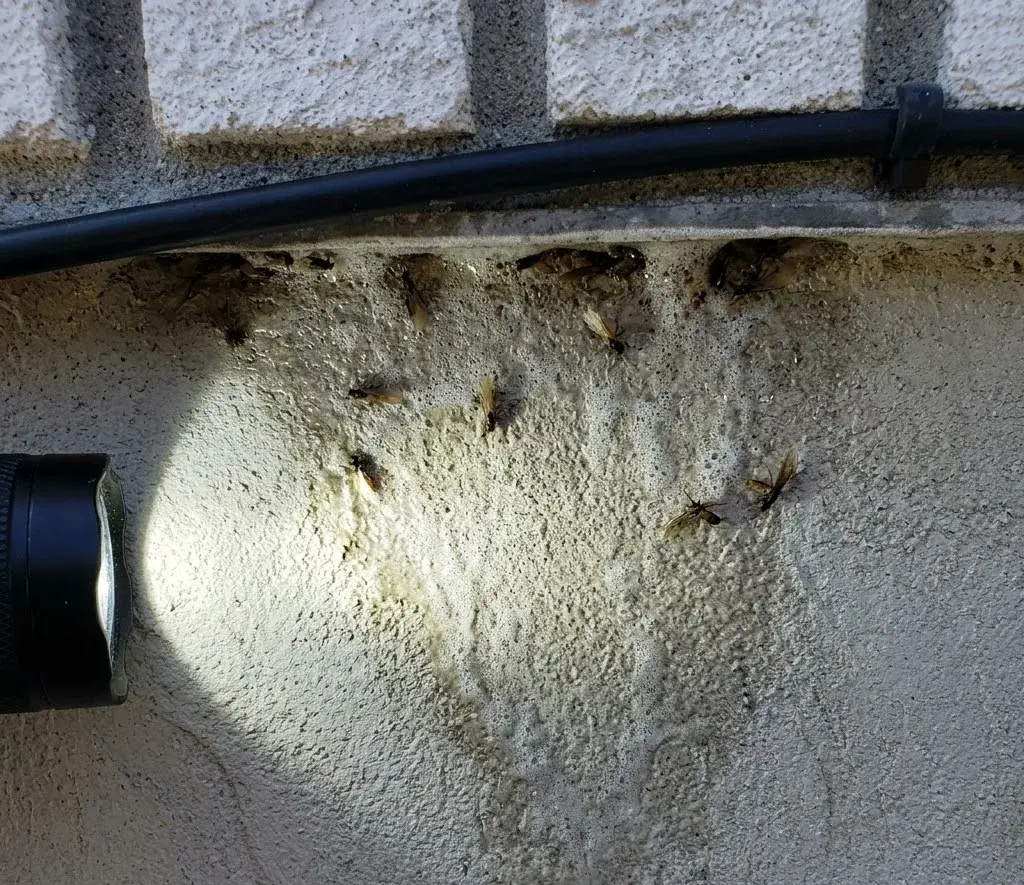
Central Texas swarms happen in daylight after a warm rain, most often between February and May, with Williamson County typically a little later in that window than the counties south of here. A swarm is winged termites leaving an established colony to start new ones, so seeing one at a place like Wolf Ranch or Berry Creek does not mean an infestation just started. It means one has been building for a while and reached the point of spreading. The insects themselves rarely make it inside in numbers; what a homeowner usually finds afterward is the evidence they left behind.
What to Check For
A swarm is the easiest confirmation, and in this part of Central Texas it tends to show up after a rain sometime between February and May, in daylight, with discarded wings left behind on a sill or a porch ledge near Old Town or out along Serenada's older lots. Between swarms, look for mud tubes running up a pier, a porch step, or the edge of a slab where siding meets ground. None of that means Formosan termites, which have not turned up in Williamson County; that species is a Travis County concern for now, not a Georgetown one. What Georgetown has is pressure from the native colony already in the ground.
Is Treatment Worth It
Given how established this termite is in the local soil, prevention is generally worth more than waiting for visible damage, especially on slab-on-grade construction where the vulnerable wood sits close to ground level throughout Georgetown. A newer home in Teravista or Wolf Ranch Town Center is not exempt just because the construction is recent; termites do not check a permit date before finding a gap. The honest comparison a licensed pro can walk through is inspection cost against the cost of a colony left alone for a few more seasons, since subterranean colonies tend to keep growing rather than stall out on their own.
Dealing with this in your home?
Georgetown posts start the same way, and it always shows: a scorpion crossed the tile at midnight, a fire ant mound came up overnight off Williams Drive, something is moving in the attic above Berry Creek. This page pulls those threads apart one at a time — what the striped bark scorpion actually wants, why roof rats never touch your slab, why the San Gabriel doesn't explain the ants. By the end you'll know which of those calls can wait until morning.